Menu

Blog
Water Filter Bag Explained: Everything Plant Engineers Need to Know
Jul 09 2026
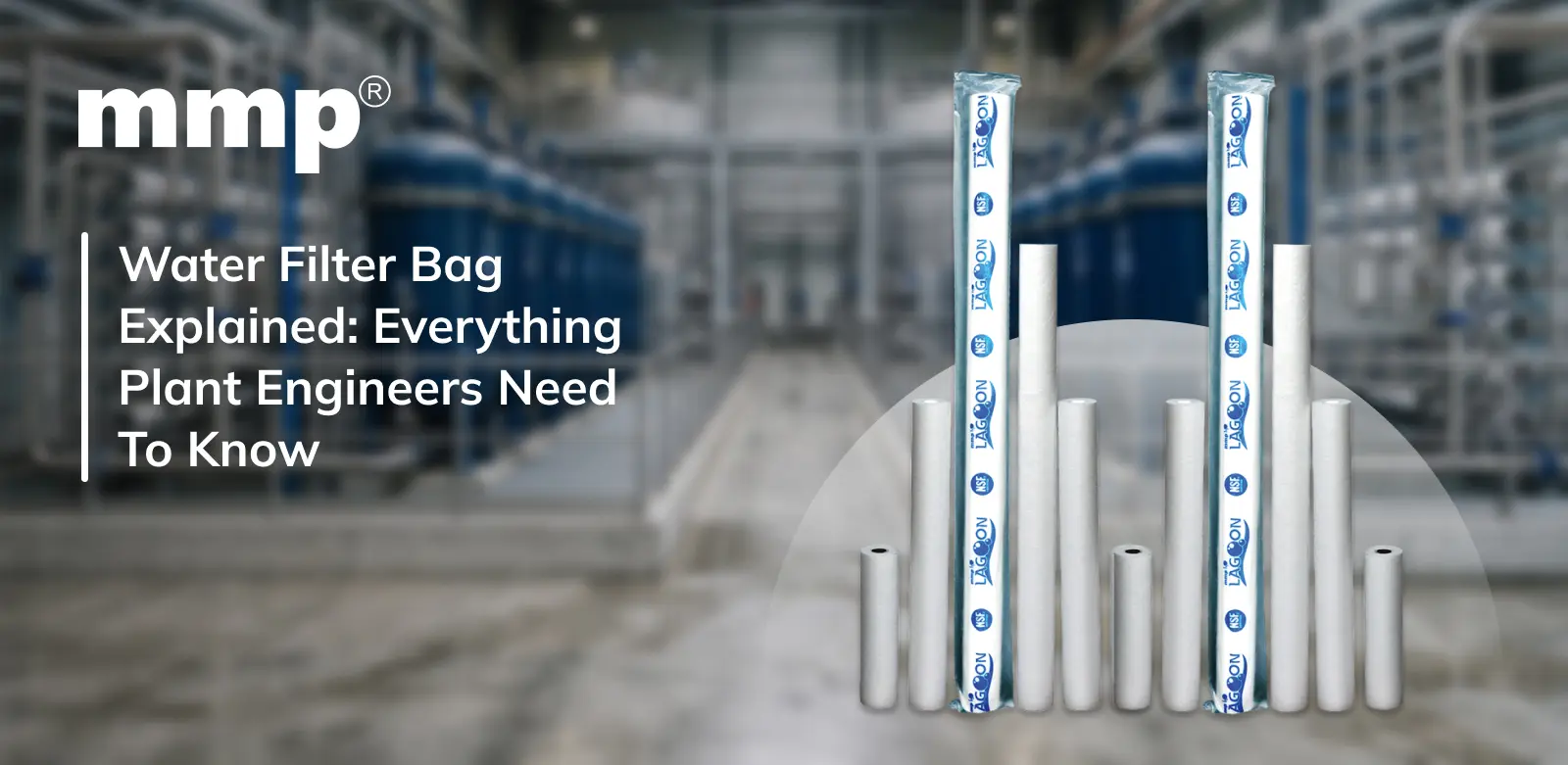
Water that looks clean is rarely as clean as it needs to be. All types of process, supply, and cooling water contain tiny suspended solids. Rust, scale, sand, sediment, and numerous other particles can corrode equipment and contaminate product. For many plants, a water filter bag offers a basic, effective, and reliable way to strain out unwanted contaminants.
Plants mostly go wrong with their choices. The wrong media, micron rating, or size means your bag clogs up fast, leaks, or allows solids through the filtration material (all of which quietly increase your costs), whereas the right choice protects a great deal of expensive equipment.
What Is a Water Filter Bag?
A water filter bag is made of sturdy fabric that collects particulates as water passes through. The filter is installed in a housing where dirty water enters, clean water exits, and dirt is trapped in the bag.
They store vast amounts of contaminants before being replaced, are capable of handling very high volumes of water, and only take up two or three minutes to replace. That combination of high capacity, easy service, and low price point means industrial water filter bags are used in just about every plant that processes large volumes of water.
Learn More: What Are Industrial Bag Filters and How Do They Work?
How Does a Water Filter Bag Work?
The work mechanism is very simple: the bag sits in a filter bag housing, which consists of a metal container that contains a basket to support the bag, to retain it at high pressures. Water enters the top open end of the bag and then goes out from the bottom through the bag wall.
In almost all systems, the air flow is from the inside to the outside. The contaminants remain in the bag, so when it is time to be replaced, all the dirt is sealed in, resulting in an easy-clean change. Industrial filter bags capture particulates by one of two methods:
- Depth filtration: Felt bags capture particles over the entire thickness of the media, which allows for a high dirt-holding capacity.
- Surface filtration: Mesh bags capture particles at the surface of the mesh, making them ideal for coarse filtration and systems that are reused.
The micron rating is where the filtration is determined, and we go deeper into this below. When the correct filter bag is fitted and it has been sealed properly into its housing, it will trap particles down to the micron size without leaking past the filter bag.
Water Filter Bag vs. Cartridge Filter: Key Differences for Industrial Use
Both bags and cartridges filter water, but they suit different jobs. The right choice depends on the flow volume and how much solid the water carries.
| Factor | Water filter bag | Cartridge filter |
|---|---|---|
| Dirt-holding capacity | High | Lower |
| Cost for high-volume water | Lower to run | Higher |
| Change-out time | Fast | Slower |
| Best fit | High flow, heavy solids | Fine polishing, low solids |
| Maintenance frequency | Less often | More often |
Basically, a liquid filter bag is ideal when you need to transfer a large quantity of water that contains a significant level of solid matter. When ultra-fine final polishing or low-solid requirements exist, cartridges remain ideal. Some systems implement a combination of both, using bags for the larger jobs and cartridges for the final polishing.
Types of Water Filter Bags: Felt, Mesh, Welded & High-Capacity
There is no single "best" bag. The right type depends on the water and the duty.
| Type | Designed for |
|---|---|
| Felt | General depth filtration with high dirt-holding capacity |
| Mesh | Coarse filtration and reusable, straining-type duties |
| Fully welded | Leak-free, high-pressure, and hygienic work with no stitch holes |
| High-capacity | Larger surface area for high flow and longer service life |
Felt is the general-purpose material used in most water filtration applications. Mesh is used for simple straining only. Welded bags eliminate the stitch holes and ensure no bypass occurs. High-capacity filters extend the time between change-outs in heavily used lines.
See Also: Types of Industrial Filter Bags Used in Dust & Liquid Filtration
Filter Bag Materials Compared: Polypropylene, Polyester, Nylon, PTFE & More
How well your bag withstands water's chemistry and temperature comes down to its material. Pick the right one, and that’s basically all you need to know.
| Material | Suited for |
|---|---|
| Polypropylene | Water and most corrosive liquids have wide chemical resistance |
| Polyester | Oils, mild acids, and higher-temperature water |
| Nylon | Abrasive, coarse, and reusable straining duties |
| PTFE | High-temperature and chemically aggressive fluids |
Polypropylene filter bag is the best selection for general water filtration because it is highly chemical-resistant and holds up to typical process water. A polyester filter bag is suitable for water that runs a bit warmer or has an oil or acid component. For those very hot and aggressive streams, you can go with the PTFE option.
To prevent any confusion with filter bags versus water absorbent bags: the latter contain a material to absorb a spill or water pooling around a spot on a surface, but filter bags separate solids from flowing water, not absorb it.
Understanding Micron Ratings in Water Filter Bags: Nominal vs. Absolute
The micron rating tells you the size of particle a bag can trap, measured in microns (one millionth of a metre). Lower numbers mean finer filtration.
| Range of micron | Best suited for |
|---|---|
| 1 to 5 microns | Fine polishing and protecting sensitive equipment |
| 10 to 25 microns | Medium filtration of process water |
| 50 to 100 microns | Sediment removal and pre-filtration |
| 150 to 200 microns | Removing larger debris |
There are two ways a rating can be identified. A nominal rating actually traps a percentage of particles at the specified size. An absolute rating provides a more consistent, effective performance, offering a closer, more controlled standard of removal. For processes where accuracy and consistent clarity are paramount, opt for an absolute micron filter bag.
Filter Bag Sizes Explained
Water filter bags come in standard sizes and come with a compatible housing size. Correct size is crucial to preventing leaks and bypass; if the bag does not create a good seal, the filtered water bypasses the bag.
| Size | Approximate dimensions |
|---|---|
| Size 1 | About 7-inch diameter x 16 to 17-inch length |
| Size 2 | About 7 inches in diameter x 32 inches in length |
| Size 3 | About 4 inches in diameter x 9 inches in length |
| Size 4 | About 4 inches in diameter x 14 to 15 inch length |
Always compare the size with your existing housing & filter basket before placing an order, as slight differences in diameter and seating of the ring cause leakage/bypass. If the housing size is not standard, a custom size may be fabricated to fit perfectly.
Read More: Custom Bag Filters: Types, Benefits & Applications
How to Choose the Right Water Filter Bag for Your Plant
Choosing well comes down to buying the right bag for your actual conditions, not just selecting a part number. Approach it in order:
- Define the water. The material of choice is based upon the operating temperatures, pressures, and the chemical compatibility of the liquid.
- Determine the Micron Rating. Whether you require a nominal or absolute type filter depends on the size of contaminants to be removed, which dictates this specification.
- Match the housing. The housing and basket must be sized to ensure that the sealing ring will fit tightly and without issue.
- Choose the construction: Stitched for general use, fully welded for high pressure or hygiene.
- Plan for load. To mitigate the need to replace media for large solids, try higher-capacity media or media with a longer lifespan.
Get these five right, and the bag will fit and perform on the first attempt rather than leaking, failing prematurely, or becoming clogged.
Best Practices for Installing and Replacing Water Filter Bags
A good bag still needs a good install to perform. A few simple practices make a real difference:
- Completely seat the bag: Ensure that the sealing ring is even against the housing lip without folds to prevent any water ingress.
- Inspect the basket: Check the support basket for any tears and damage prior to fitting the new bag.
- Monitor the pressure: Replace the bag once the pressure drop across it reaches the setting you established, instead of on a set calendar.
- Replace cleanly: Gently remove the bag so the dirt it trapped stays on the dirty side.
- Inspect on change-out: Check the used bag for any breaks or tears, as it can be indicative of a media or sizing problem.
This is an effective measure as it protects the subsequent equipment downstream and ensures even filtering across successive bags.
Industry Applications of Water Filter Bags
Given that the material, micron rating, and size can be customised to suit the task, you will see water filter bags in practically any sector that deals with water.
- Water filter bags for water treatment eliminate solid and suspended particles in feed and process water.
- Filtering the water used for the production process separates the particles from chemical active streams.
- In the food and beverage industry, it purifies process water in a hygienic environment.
- In the Pharmaceutical sector, it filters out particle contamination under traceable conditions.
- In the Power & Engineering domain, it is used for the filtration of cooling water, as well as industrial fluids.
- In the Municipal & industrial supply, generic bag water filter treatment is done to prevent damage to downstream pumps, membrane units, and general systems.
Why Plant Engineers & Procurement Teams Choose MMP Bag Filter
mmp has been manufacturing liquid and water filter bags since 1994, with over 30 years of producing filters for the rigors of industry. mmp manufactures its products in-house; it designs and builds all its filtration, and it tests each bag before it's packaged for you to ensure that each bag provides accurate micron retention and has no leakage.
Also, the media range is extensive - polypropylene, polyester, nylon, PTFE, carbon, etc., ensuring there is a material suitable for all types and temperatures. Micron and size range is equally extensive - bags ranging from 1 to 200 microns, with sizes 1 to 6 standard, plus custom sizes when a housing needs them.
mmp, in addition, is equipped to serve bulk and export needs. Being a well-recognized bag filter manufacturing company and an industrial water filter bag supplier India trusts, we are the preferred choice for the OEM's & heavy bulk buyers pan-India & global.
Conclusion
An ongoing problem in industry has been finding a simple and effective solution to remove solid contaminants from process water, protecting equipment and systems. The solution to this is a simple, cost-effective, yet remarkably versatile water filter bag. It all comes down to doing the fundamentals. Use a micron-rating and the right material for your water, ensure the bag size and construction work for your flow, install it correctly, and buy from a company that maintains control of quality and that can assist at scale. You can eventually get away with low-cost bags that can save money spent on expensive equipment for an extended period of time.