Menu

Blog
What Are Industrial Bag Filters and How Do They Work?
May 25 2026
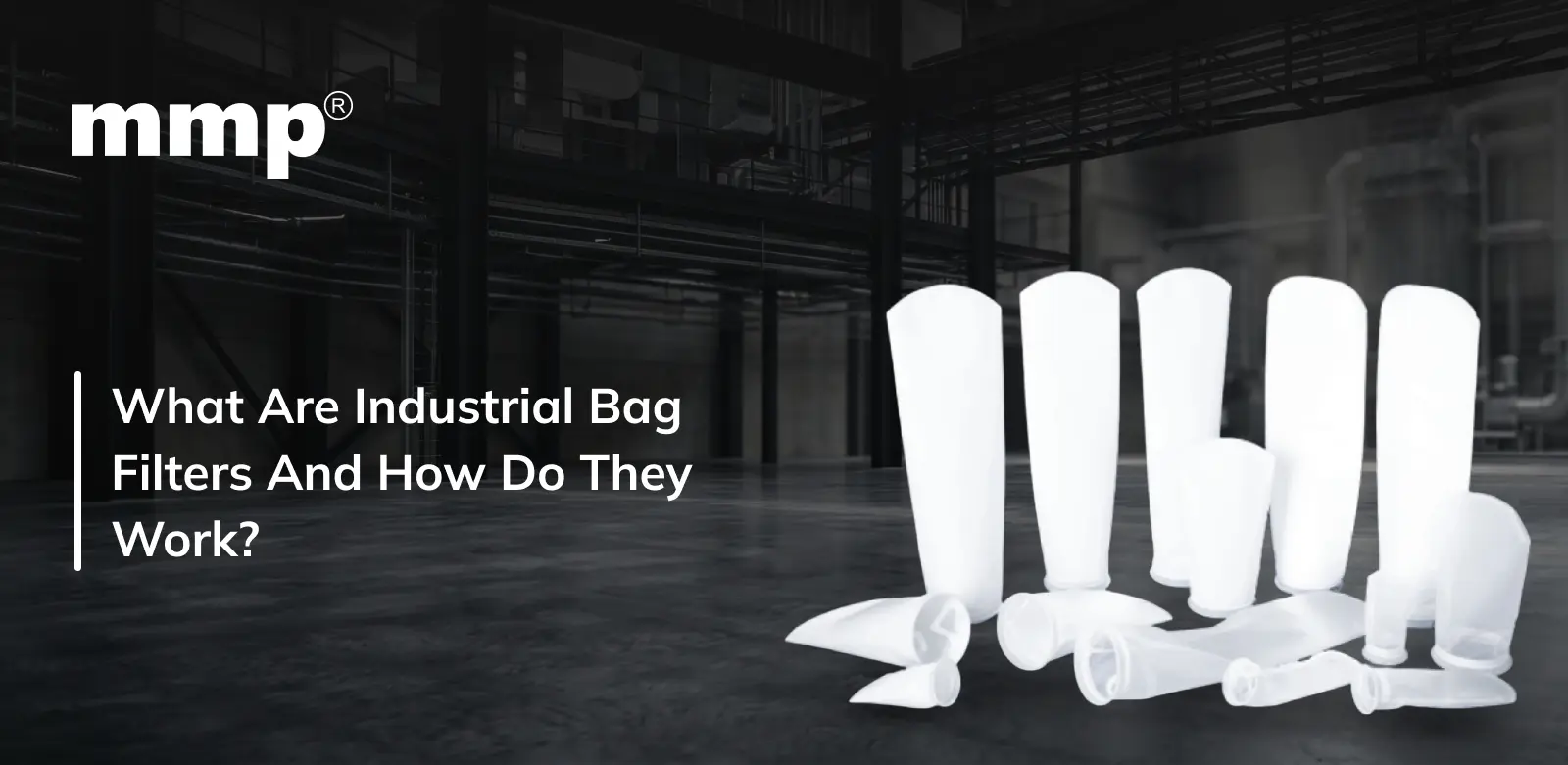
Every plant produces a certain type of dust or particle/air pollution. If it remains, it is detrimental to your equipment, quality of your product, harmful to workers, and is a source of air pollution. To solve this problem in harsh environments, industrial bag filters offer a reliable and efficient solution.
If you are considering a dust filtration system for your plant, trying to upgrade what you currently have, or just figure out what you are operating now, this guide has everything you need, from the basics of how bag filters work to selecting them for your specific task.
What is an Industrial Bag Filter?
An industrial bag filter is a device that removes dust, fine particles, and particulates from an air or gas stream by the process of filtering through fabric filter bags, which act as filter media. The dusty air passes through the fabric bags and is released as clean air, and the accumulated dust gets collected.
It is used in cement, steel, power, chemical, pharmaceutical, food processing, textile, and mining industries, in any sector where industrial dust collection is necessary to maintain clean, efficient, and safe operations.
How Does a Filter Bags Work? (Step-by-Step)
A bag filter works on a simple operating cycle. Here is a stepwise process on how it works:
Step 1- Contaminated air enters the system
Air laden with dust, from processes like a grinding mill, kiln, conveyor, or a production line, is drawn into the baghouse via the inlet duct. Depending on the process, fine and coarse particulates may enter the air at different concentrations.
Step 2 - Air goes through the filter bags
Dust-laden air is routed through the filter bags, which are hung on a tubesheet within the baghouse. The fabric holds the particles on its surface (or within its depth). Clean air flows through the fabric and exits through the outlet.
Step 3 - Dust Cake is Accumulated
During filtration, the dust cake that has been gathered begins to form on the outside of the bags. It actually contributes to a higher efficiency of filtration in the initial stages as it forms a new layer of filtration; as the thickness grows, the resistance to the air flow increases, and the pressure drop increases.
Step 4 - Cleaning cycle is activated
The cleaning cycle is activated when the differential pressure across the bags is greater than some pre-set value. It is achieved through a compressed air pulse, reverse airflow, or mechanical shaking, depending on the type of bag filtes used.
Step 5 - Dust is gathered and removed
Dust collected in the baghouse falls into the hopper at the bottom of the baghouse, and it is removed by the use of a rotary valve, screw conveyor, or by hand cleanout.
Step 6 - The process repeats
Once the cleaning process has been performed, the bags are prepared to restart the filtration process. This operation typically runs 24/7, ensuring that air in the system remains clean and the pressure drop is maintained within range.
Types of Industrial Bag Filters
All Bag Filters work uniquely. It is the cleaning process that decides the type, and it is this type that determines which application it suits.
Pulse Jet Bag Filter
This is the type generally used in industrial plants of today. The bags are installed in rows, and each row is cleaned separately from the others. A short high-pressure blast of air is directed down the centre of each bag, and the movement of the bag to and fro makes the dust cake fall from the bag.
They can clean the bags while in operation and are suitable for continuous process systems. They are smaller in size, energy efficient, and applicable to a wide variety of dusts and concentrations.
Reverse Air Filter Bag
In this system, the bags are cleaned by reversing the air flow through the bags. Soft reverse flow makes the bags collapse and the dust cake fall down the hopper.
These bag-cleaning systems are considered to be less abrasive and are better for more delicate filter media, or where bag longevity is critical. These systems can be found in large plants like power stations and other major industrial sites.
Shaker Filter Bag
A shaker bag filter cleaning system mechanically shakes the bags - a motorised mechanism that moves the bag suspension back and forth to flex the bags and shed the dust cake.
They are typically found in low-dust-load operations or when maintenance and simplicity are concerns.
Types of Filter Bag Media and Temperature Range
The type of fabric used for dust bag filters will depend upon the operating conditions and can provide a guide on main media types and temperature limits:
| Material | Temperature Limit | Suited for |
|---|---|---|
| Polyester | Up to 150°C | General industrial dust collection, cement grinding |
| Polypropylene | Up to 90°C | Water treatment, chemical environments |
| Nylon | Up to 100°C | Mineral processing, abrasive dust |
| Nomex | Up to 200°C | Asphalt plants, cement kilns |
| Fiberglass | Up to 250°C | Boilers, power plants |
| PTFE | Up to 260°C | Aggressive chemical environments, ultra-fine filtration |
| PPS | Up to 190°C | Coal-fired plants, oxidising chemical environments |
Bag Filter vs Cartridge Filter (Comparison Table)
The first and possibly the most frequently asked question when deciding to order a dust filtration system is whether to use the bag filter or the cartridge filter. Below is a comparison:
| Characteristic | Bag Filter | Cartridge Filter |
|---|---|---|
| Dust Load Capacity | Best for high industrial dust loads | Better for fine dust |
| Filter Surface Area | Large | Very high per unit volume |
| Operating Price | Less on an industrial scale | High replacement cost in heavy dust applications |
| Range of Temperature | Wide - speciality material handles more than 25 degrees | Limited material choices |
| Footprint | Larger | More compact |
| Maintenance | Scheduled bag replacement | Frequent changes in high dust conditions |
| Ideal For | Textiles, cement, steel, mining, power | Welding fumes, powder coating, and light manufacturing |
Pleated bag filter falls somewhere in between. The surface area is increased, while retaining the benefits in terms of capacity that a bag filter provides. Increasingly, they are also used for retrofitting when higher filtration efficiency is required without redesigning the whole system.
Key Parts of a Industrial Filter Bag
Knowing the elements of bag filters helps while maintaining or troubleshooting the system.
Filter bags: The main filtration media. The micron rating, material, and type of construction are chosen according to the application.
Dust collector filter cages: The wire frame that supports every bag and keeps it open under airflow. Good cage quality means good bag life- the bags are worn from the inside if the cage is bent or rusted.
Tubesheet: The separating plate between the clean air side and the dirty air side. Proper sealing is important here to prevent bypass.
Hopper: The collection vessel at the bottom of the bag filter where dislodged dust accumulates before discharge.
Pulse Valves and Compressed Air Header: In the pulse jet systems, these distribute the cleaning pulses over each row of bags. Correct maintenance of pulse valves ensures uniform cleaning.
Differential Pressure Gauge: Monitors the pressure drop. An increase in differential pressure would indicate that the bags are filling up. A sudden drop shows that the bags have blown or are being bypassed.
Discharge valve: Controls the discharge of dust from the hopper without letting the air in.
Common Bag Filter Problems & Troubleshooting
No matter how good the design, most bag filter systems will eventually develop certain problems. The most common ones are:
- High differential pressure: Inspect the operation of the pulse valve, air pressure and timing of the cleaning cycle. If high differential pressure persists post-cleaning, the bags may be blinded or have reached the end of their service life.
- Dust on the side of clean air: This signifies bag failure. i.e., hole in the bag, ripped seam or failed fitment. Determine which bag has failed by looking for any dust on the tubesheet around the individual bags.
- Uneven bag wear: Typically due to wrong inlet velocity, bad baffling, or abrasion by a damaged cage. Examine the inlet configuration and check all cages at the next bag change.
- Moisture blinding: Bag blinding due to fine dust adhering to the wet fabric can occur in bags operating in a wet gas stream. Look for condensation in the ductwork upstream.
- Collapse of the bag: This happens when flow is accidentally reversed or pulses are applied with too much force. System design should be examined as well as pulse pressure.
How to Choose the Right Filter Bags
When it comes to selecting filter bags, it’s not as easy as choosing the one that is most popular or the least expensive that you come across. It depends on matching the bag to the suitable process.
- The most crucial choice to start with is operating temperature. A basic polyester bag can operate up to 150 °C, and is sufficient for most standard industrial applications. If your process operates at a higher temperature, go for Nomex, fibreglass, or PTFE.
- If your process gas/dust stream has a corrosive element present, i.e., an acid, alkali or solvent, then your bag must have a suitable resistant material. Most chemical environments will tolerate Polypropylene. Highly aggressive chemistries require PTFE or PPS.
- The size of the dust load, as well as the particle size, affects the specification. A heavy dust load would demand structurally sound fabrics. Very fine particles could demand membrane-laminated media.
- Consider the cleaning mechanism of your system. A pulse jet, a reverse air, or a shaker system will place different stresses on the fabric of the bag. A bag designed for pulse jet cleaning might fail if it's placed in a reverse air system, and vice versa.
- If liquid filtration is also part of your operation in addition to dust collection, that should also be addressed. Liquid filter bags are designed as per material compatibility with the fluid being processed, the micron rating of the media and its construction type, and are something which can not be treated as an afterthought.
Why Choose MMP Bag Filters
mmp has been manufacturing custom industrial bag filters for various industry applications since 1994. It has a dedicated industrial bag filter manufacturing division offering a wide variety of filter bags.
If a plant has non-standard requirements in terms of size or chemical resistance, the custom manufacturing capability at mmp ensures that the correct bag is constructed for you. Each bag that leaves the plant is to a certain specification. The weight of fabric, the type of seam construction, dimensional tolerances, and quality of materials are monitored from batch to batch.
There are different industries that use the industrial bag filters from mmp in their applications. These include steel and metal processing, cement, pharmaceutical, chemical processing, food and beverage, water treatment, oil and gas, textile, etc.
Maintenance Tips Of Industrial Filter Bags
1. You should monitor the differential pressure on a day-to-day basis as it is a primary indicator of the bag’s health.
2. Bent, corroded, or worn cages lead to premature bag failure. Replace them when you replace the bag-don't wait for visible wear and tear.
3. Check material, fabric weight, seam detail and fitment against the original specification when re-ordering - don't assume a cheaper alternative will be just as good.

Conclusion
Among industrial dust/particulate control, one of the most efficient and reliable means is the dust collector filter bags for heavy industrial applications. Specified correctly - right material, right construction, and right micron rating for the job, they can operate for many years.
It's all about the decision that must be made before installation. You must specify the correct type of system, the correct bag filter media, and the correct fabricator. Make sure to get this right, and the system will run itself.
mmp has the right manufacturing expertise, the range of materials and the application knowledge - be it for specification, replacing a system, or to resolve a problem. Talk to mmp today!